
• Link to Instagram
  • Link to Youtube
  • Link to LinkedIn
Telephone:- +44 (0) 1767 600232
Banking Card & Passport Production Machinery | Oasys Technologies
  • Home
  • About us
  • Services
    • Banking Card Systems
    • Passport Production Systems
    • Contact board and sheet cleaning
  • Products
    • Collators
      • OHC100/OHC150 Hand Collators
      • OCL450H Hand Feed Semi-Automatic Collator
      • OCL500 Fully Automatic Collator
      • OCL600 Fully Automatic Collator
      • OCL700 eID Fully Automatic Collation Machine
    • Laminators
      • OLA1 – Single Stack Laminator
      • OLA2 – Single Stack Laminator
      • OMTS-2S Single Set Twinstack Laminator
      • OTS Range of Twinstack Laminators
      • OMTS Range of Compact Twinstack Laminators
      • OLA6E ID & Passport Laminator
    • Punches
      • OCC110 Single Card Punch Cutter
      • OEP200 Series Punch Machine
      • OCP300 Series Punch Machines
      • OCP330A Passport Data Page Cutting System
      • OCP400 Series High Speed Punch Machines
      • OCP400R High Speed Punch With Auto Card Boxing System
      • OCP433P Multi Form Factor Progression Punch
    • Guillotines
      • ODG500 Fully Automatic ID/Passport Datapage Cutting System
      • ODG600 Fully Automatic Double Guillotine
      • OSG800 Single Guillotine
    • eID Datapage Solutions
      • OSP100 eID Hole & Slot Punching Machine
      • OCL700 eID Fully Automatic Collation Machine
      • OCP700 eID Collation Machine
      • OMTS-2S Single Set Twinstack Laminator
    • Testing Machines
      • OLA6E ID & Passport Laminator
      • SDE Electric Die Cutting Machine
      • OEP200 1-up PVC/PC Punch
      • OFT100 Flex and Torsion Tester
    • Tapelayers
      • OTL200 Tapelayer
      • OMT165 Monolayer
    • Card Material Cleaning Systems
      • OCC1000 Cleaner
  • Maintenance
  • Careers
  • News
  • Contact us
  • Click to open the search input field Click to open the search input field Search
  • Menu Menu

The Card Sandwich Conundrum: How Many Layers Are Too Many?

February 9, 2021/by admin

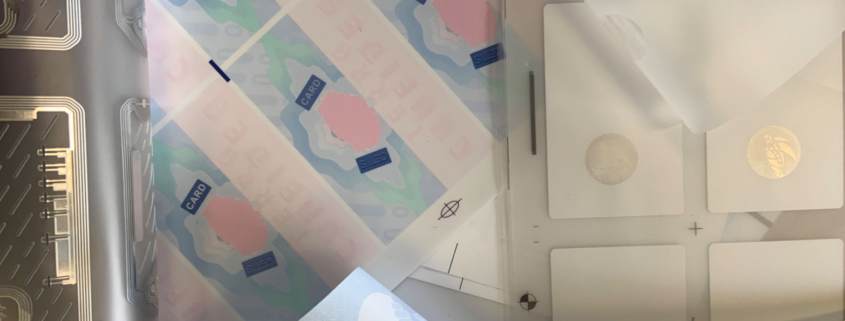
Credit cards and smartcards used to be like BLTs, consisting of printed card images on sheets with three or four layers. Now they are more like super club sandwiches with eight, nine or even 10 layers—particularly in the identification credential arena.

Identity credentials, such as ePassport pages and ID cards, have security features contained in the layers of their structure. As the number of security features increases, the layer count increases. So what?

These layers need to be in a certain order, orientation and accurately aligned—all of which can make the assembly process rather slow.

A person can typically assemble the four layers that make up a typical bank card sheet (set) in the correct order and orientation in around 30 seconds (without taking accuracy into account). So, based on a typical card sheet (48 cards to view), the simplest card structures can be assembled at rate of around 5,000 cards per hour.

Card production systems typically need to produce five to 10 times that amount. So, if assembly is not to become the bottleneck in the process, five to 10 people per shift would be required for that single stage of production.

Increasing the number of layers to eight (that’s one big sandwich!) takes more than twice as long. That’s before accuracy, mistakes and scrap are taken into account. You can now start to see the issue.


Assembling the ‘Super Sandwich’

More layers—holographic layers, laserable layers, antenna layers and window structures to name a few—mean more functionality and more security in ID products. Assembling all these layers accurately slows the assembly process down. So, how does manufacturing technology keep up and how many layers are too many?

At this level of complexity, automatic assembly/collation is the only practical solution as ID and smartcard-style products require accurate alignment and a high level of consistency. ID cards or licences with variations are always subject to the question, “Is this genuine?” At the same time, many millions of cards or passports need to be issued within a particular timescale to meet national rollouts.


The ‘Super Sandwich’ Assembly System

A modern automatic assembly system is typically six to 12 times faster than manual collation with a much higher yield. Automatic machines that assemble card and ID sandwiches (collation systems) have been around for a while, but recent advancements have considerably improved their speed and accuracy.

Like any sandwich, the layers vary in thickness and consistency. The layers in ID card structures have become much more challenging and require a new level of automated technology to assemble them reliably and fast. There are three main challenges:

  1. Alignment: As the number of layers increases, “drift” occurs. Whereby the more layers that are added, the greater the overall error in the set/stack. As you layer your sandwich, it inevitably starts to lean to one side. This happens when each layer is not stacked correctly on the previous layer.
  1. Material: Different layers need different alignment solutions. For example, registering (aligning) the position of a transparent hologram needs a different sensor than positioning a buried RFID antenna layer that you can’t actually see.
  1. Thickness: The sandwich in this case must also be within ISO standard thickness. And so, the more layers there are, the thinner each layer will need to be; 25 microns is now not uncommon. This thickness is notably harder to feed, register and position with the same accuracy, speed and consistency. Try picking up a very finely sliced piece of onion without it tearing, folding or breaking up!

These challenges have mostly been overcome with the advancements of automated collation systems using a combination of print, induction and optical sensing systems.


How to Increase Layer Count

Having a machine that handles eight to 10 different sandwich layers simultaneously is possible, but it is not practical for most security printers. There are more practical ways to handle the “super sandwiches” and increase the system’s flexibility.

One way around this issue is to run sub-assemblies in which you assemble two to four layers in a “first run” process and then run them back through the machine as a “single” layer in combination with more outer layers to complete the build. Handling a project this way, the system can cope with more layers when necessary but can still be small enough to carry out more standard card assembly runs (four to six layers). Additional technology is needed to enable this process to work successfully and maintain quality and accuracy throughout the whole layer count. This is where state-of-the-art ID and card “sandwich making” is these days.

So, maybe spare a thought the next time you “tap and go” while buying your lunch—the card you use may have more layers than the club sandwich you just bought.


Author: Elliot Lamb – OASYS Technologies (08/02/2021)

https://www.oasys.uk.com/wp/wp-content/uploads/2021/02/oasys-technologies-passport.jpg 1036 1566 admin https://www.oasys.uk.com/wp/wp-content/uploads/2020/10/oasys-technologies-logo2.png admin2021-02-09 11:35:242021-07-04 08:44:55The Card Sandwich Conundrum: How Many Layers Are Too Many?

Pages

  • About us
  • Banking Card Systems
  • Careers
  • Collators
  • Contact board and sheet cleaning
  • Contact us
  • Cookies
  • EID
  • Guillotines
  • Home
  • Home -Old
  • Laminators
  • Maintenance
  • News
  • OCC1000 Cleaner
  • OCC110 Single Card Punch Cutter
  • OCL450H Hand Feed Semi-Automatic Collator
  • OCL500 Fully Automatic Collator
  • OCL600 Fully Automatic Collator
  • OCL700 eID Fully Automatic Collation Machine
  • OCP300 Series Punch Machines
  • OCP330A Passport Data Page Cutting System
  • OCP400 Series High Speed Punch Machines
  • OCP400R High Speed Punch With Auto Card Boxing System
  • OCP433P Multi Form Factor Progression Punch
  • OCP700 EID Collation Machine
  • ODG500 Fully Automatic ID/Passport Datapage Cutting System
  • ODG600 Fully Automatic Double Guillotine
  • OEP100 1-up Electric Punch
  • OEP200 1-up PVC/PC Punch
  • OEP200 Series Punch Machine
  • OFT100 Flex and Torsion Tester
  • OHC100/OHC150 Hand Collators
  • OHP 200
  • OLA1 – Single Stack Laminator
  • OLA2 – Single Stack Laminator
  • OLA6E ID & Passport Laminator
  • OMT165 Monolayer
  • OMTS Range of Compact Twinstack Laminators
  • OMTS-2S Single Set Twinstack Laminator
  • OMTS-2S Single Set Twinstack Laminator
  • OSG800 Single Guillotine
  • OSP100 EID Hole & Slot Punching Machine
  • OTL200 Tapelayer
  • OTS Range of Twinstack Laminators
  • Passport Production Systems
  • Privacy Policy
  • Punches / Card Cutting
  • Recycled Plastics
  • SDE Electric Die Cutting Machine
  • Tapelayers
  • Terms and Conditions
  • Testing Machines

Categories

  • News

Archive

  • April 2024
  • November 2023
  • July 2021
  • March 2021
  • February 2021
  • June 2018
  • November 2017
  • July 2017

OASYS TECHNOLOGIES

Oasys Technologies is a specialist manufacturer of banking card machinery, passport datapage construction machines, contact sheet cleaning systems, smart card production equipment, card collators, laminators, punches and eID manufacturing solutions for the global secure identity, banking card and passport production industries.

LATEST NEWS

  • Oasys supply passport data page processing machine to Turkish Mint – Nov ’23April 29, 2024 - 9:58 am
  • New OCP330A Passport Data Page Cutting System & Trustech exhibition!November 24, 2023 - 12:12 pm
  • 37 Years in the industry…. Can anyone beat that !!July 4, 2021 - 8:57 am

WHERE WE ARE

GET IN TOUCH

OASYS TECHNOLOGIES LTD
3 Gosforth Close
Sandy
SG19 1RB
United Kingdom

Phone: +44 (0) 1767 600232

Email: sales@oasys.uk.com

Service: service@oasys.uk.com

Spares: spares@oasys.uk.com

© Copyright - OASYS Technologies 2020 - Design by Creative Bone | Terms and Conditions | Cookies | Privacy
  • Link to Instagram
  • Link to Youtube
  • Link to LinkedIn
Scroll to top Scroll to top Scroll to top
We use cookies on our website to give you the most relevant experience by remembering your preferences and repeat visits. By clicking “Accept”, you consent to the use of ALL the cookies.
SETTINGSACCEPT
Privacy & Cookies Policy

Privacy Overview

This website uses cookies to improve your experience while you navigate through the website. Out of these cookies, the cookies that are categorized as necessary are stored on your browser as they are essential for the working of basic functionalities of the website. We also use third-party cookies that help us analyze and understand how you use this website. These cookies will be stored in your browser only with your consent. You also have the option to opt-out of these cookies. But opting out of some of these cookies may have an effect on your browsing experience.
Necessary
Always Enabled
Necessary cookies are absolutely essential for the website to function properly. This category only includes cookies that ensures basic functionalities and security features of the website. These cookies do not store any personal information.
Non-necessary
Any cookies that may not be particularly necessary for the website to function and is used specifically to collect user personal data via analytics, ads, other embedded contents are termed as non-necessary cookies. It is mandatory to procure user consent prior to running these cookies on your website.
SAVE & ACCEPT

Thank you for taking an interest in an Oasys Technologies product, please fill in your email address and a downloadable PDF link will be sent to you.


    Thank you for taking an interest in an Oasys Technologies product, please fill in your email address and a downloadable PDF link will be sent to you.


      Thank you for taking an interest in an Oasys Technologies product, please fill in your email address and a downloadable PDF link will be sent to you.